

Welcome to the Experimenter’s Edge.
Each month I share what I’m seeing in rapid experimentation training and consulting work, what’s shipping inside Rapidly, and a technique or two you can use this week. Glad to have you here, alongside 1,000+ pretotypers, product leaders, and experimenters.
Last month I said I was building this. It shipped.
Last month I told you I was working on closing the gap between an AI-built idea and the first real experiment. It’s now live, and in week one it generated 46 ideas for real companies. The most useful thing it did was stop more than half of them.
The stopping is what matters to me. Generating ideas is easy now and every tool does it, but working out which ones to bin is the harder and more valuable job, and it’s where the money sits: a valid idea makes money, a failed one saves it.
You already know the setup, because I’ve been banging on about it for months: building is cheap, a demo isn’t a validated product, and the only way to know is to put it in front of a real person and measure what they do. What’s changed is that validation can finally keep pace with the build, with human judgement kept in the loop. That’s what drove the biggest update we’ve shipped in Rapidly, our software for brainstorming, training, and consulting work.
What we shipped: the AI Idea Generator in Rapidly
Here’s what it does: it generates high-quality ideas specific to what your company is doing, then moves them straight into experimentation with the rigour of a lean canvas, a pretotype, and a hypothesis.
You choose how to work.
Create an idea manually for workshops.
Generate up to 20 ideas for your company, deduped against what you’re already doing, each with a rationale.
Drop in one idea and have it build everything out like the validator.
Or take an idea you’re working on and augment just the parts you want.
Yes, you could ask Claude, Fable, or Codex to do the same. The difference is that we’ve embedded the proven pretotyping method and refined it against our own IP and real experiments at scale, so the AI works as an enabler rather than an “AI!” button bolted onto a form. As I put it when we launched, the leverage isn’t in generating more ideas; it’s in generating better-context ideas and moving them into evidence faster.
It’s a first pass and it’s running live, so give it a go at rapidly.co and tell me what you think.
Spotted in the wild
Validate before the build decision. Teams whose engineering capacity has jumped are watching their backlog grow faster than they can test. The fix is to run a handful of real experiments before the big build call rather than after it, which is about the cheapest insurance you can buy.
Turn a backlog into decisions. Some of the most useful work is taking a stack of plausible ideas and producing a prioritised shortlist with a proceed, sequence, or stop call on each one. Being able to say what you won’t do is worth as much as the green lights.
Tool of the month: Ploy.ai
I handed Ploy.ai a PDF (drafted by Nous Research Hermes from Gbrain and Granola data) and it spun up two live sites built for AEO, roughly six hours of effort for what would usually take months. Rapidly.co and Exponentially.ai are both live off the back of it.
Fair warning: you probably won’t like those sites, and that’s fine, because they’re built for agents to find and consume, not for you. That’s the whole point of the experiment. The offers and products behind them are real, so they aren’t the pretotype; the pretotype is whether you can hand this kind of work to a service that keeps optimising, or whether it just turns into AI slop.
I’d call ploy.ai an inflection point rather than just another web builder because of the choice it represents. You could script this yourself in Claude and then maintain it forever, or you could lean on a curated set of skills with the AI judgement already built in. I’ll take the second every time.
Which of your half-built ideas has touched a real customer?
If the honest answer is none, pick one this week, define the smallest behaviour that would prove it, and test it with the simplest pretotyping method that fits: a Fake Door for intent, a Mechanical Turk to deliver the outcome by hand, a Pinocchio for a non-operational version, or a One Night Stand for a strictly limited live window.
Reading
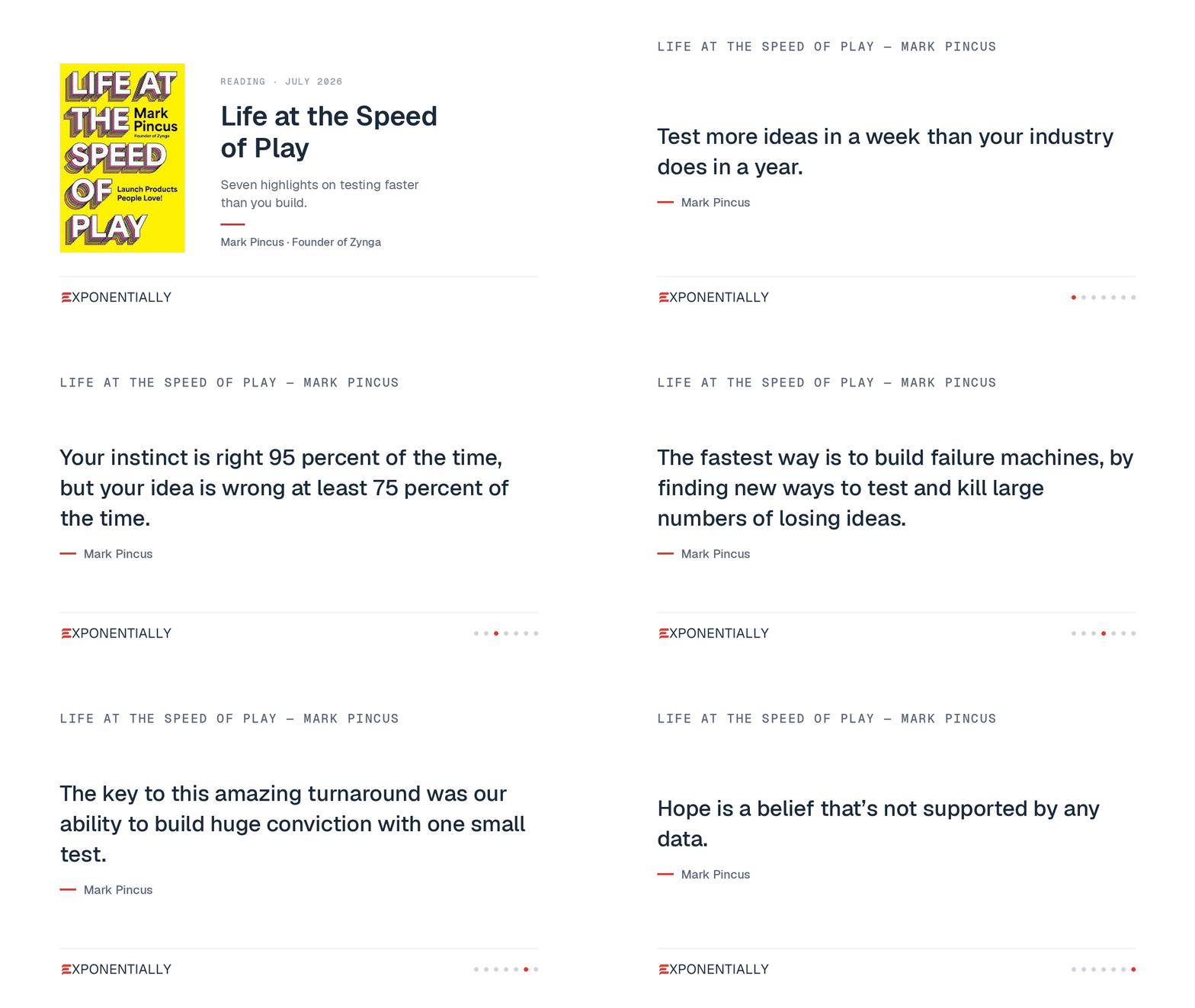
“Do you know what to build, how to test it, and when to kill it?” Having a strategy to rapidly test ideas, identify the promising ones, and ruthlessly eliminate the rest isn’t just valuable—it’s essential. And that’s exactly what this book gives you
Life at the Speed of Play by Mark Pincus, Zynga Founder
Find the best ideas to invest in
We help teams go from ideas to evidence in weeks, building rapid experimentation into their work so they can validate fast, stop the wrong ideas early, and back the winners with confidence.
Want to talk it through? Reply and we’ll set up a short call. Or just try the new AI Idea Generator or the free Idea Validator
Until next month, happy innovating!
Leslie